%20(1).avif)
.avif)


Most dental practices measure marketing by the wrong number. They watch total website traffic, or the practice's ranking for its own name, and conclude things are healthy. Neither tells you the one thing that actually matters: whether a patient who has never heard of you can find you, and choose you, at the moment they are ready to book.
After running competitive analyses across more than 1,500 practices, I have found that findability comes down to four signals. When a practice is losing new patients to a competitor down the street, it is almost always failing on at least one of them, and usually the owner has no idea which. This is the framework I run on every discovery call. Below is the full version, so you can score your own practice this week. If you want the audit I run for practices, including the AI-visibility component, it lives on my personal site.
Why the usual metrics lie
Total sessions go up when you run a promotion, when an old blog post catches a seasonal wave, or when your own staff and existing patients visit the site. None of that is new-patient demand. Ranking number one for your practice name is worse than useless as a health check, because the people typing your name into Google already know you. They are not the patients you are trying to win.
The four signals below are deliberately chosen to measure the opposite: your visibility to people who do not yet know you exist, across the four places they actually look. Score each one honestly from 1 to 5 as you read.
Signal 1: Local Search Authority
When someone searches "dentist near me" or "orthodontist in [city]," Google decides who appears in the local map pack using signals most practices never audit: Google Business Profile completeness, review velocity (not just total review count, but how recently and steadily reviews arrive), proximity, and how quickly you respond to reviews and questions.
Check your own profile honestly. Are all services listed as individual services, not buried in a description? Are your hours, categories, attributes, and photos complete and current? Have you responded to your last ten reviews? A practice with 400 old reviews and no recent activity routinely loses the map pack to a newer practice that earns and responds to reviews every single week, because review velocity signals an active, trusted business. Proximity you cannot change, but completeness and velocity you can, and they are where most of the ranking movement happens.
This is the deepest of the four signals, and it has its own field guide. If Signal 1 is where you score lowest, work through our 2026 local SEO field guide for the Map Pack and lean on our dental SEO services, which start here for a reason.
Signal 2: Findability for the procedures that pay
This is where the "we rank fine" illusion breaks. Ranking for your practice name is not findability. What matters is whether you rank for the treatments that actually drive revenue: "Invisalign in [city]," "dental implants [city]," "emergency dentist [city]," "clear aligners near me."
Run a few of your highest-value service searches in an incognito window, from outside your office network. If you only appear for branded terms and not for the treatments that pay, you have a service-page coverage problem. The fix is structural: every core procedure needs its own dedicated, genuinely useful page, with real content about cost ranges, candidacy, what to expect, and recovery, not a single line on a combined "services" page. Practices that treat their website as one brochure page consistently lose to practices that build out a real page per procedure, because Google cannot rank a page that does not exist for a query it never targets.
Signal 3: AI Search Visibility
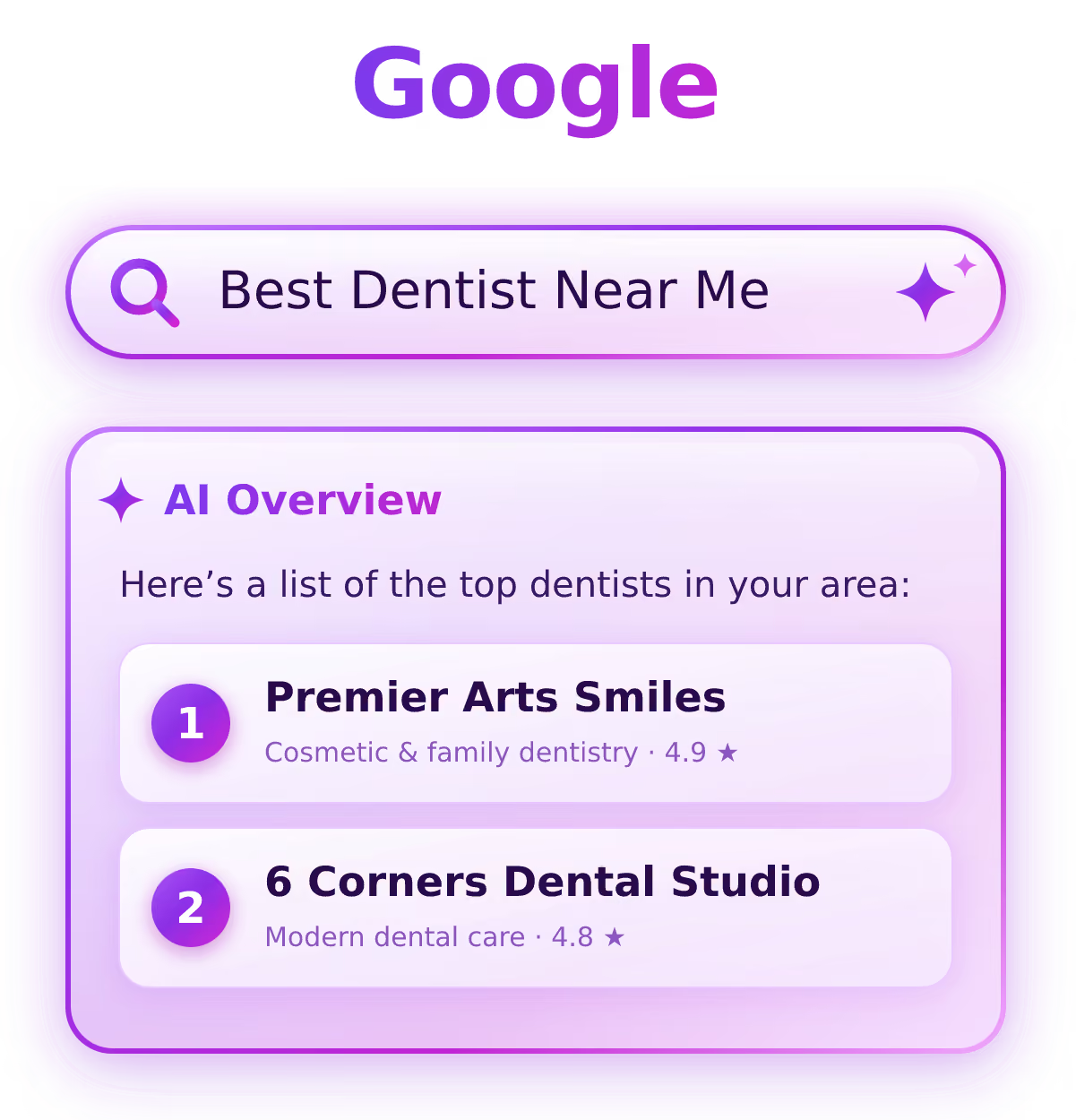
This is the fastest-growing front door in dentistry and the one almost nobody audits. When a patient asks ChatGPT, Perplexity, or Google's AI Overviews "who is a good orthodontist in my area," does your practice get named? Increasingly, that recommendation happens before the patient ever sees a traditional list of ten blue links.
The mechanics are different from traditional SEO. AI engines assemble answers from structured, machine-readable signals and from being clearly and consistently described across the web. Structured data and clean entity information (who you are, where you are, what you do, corroborated across your site, your profile, and third-party sources) determine whether an AI engine can confidently recommend you by name. I covered which practices actually get surfaced by AI engines, and the patterns behind it, in the 2026 Dental AI Search Visibility Report, and Lasso MD's own approach is documented in our guide to AI search visibility for dentists. To test it yourself, ask two or three AI engines for a recommendation in your city and see whether you appear, and how accurately you are described.
Signal 4: Conversion Readiness
The first three signals get a patient to your site. This one decides whether that visit becomes a booked consult. Site speed, a booking flow that works on mobile in under a minute, and service pages that answer the questions a nervous patient actually has (cost, payment plans, insurance, what the first visit is like) all determine your conversion rate.
To score it, open your own site on your phone as if you were a first-time patient. Time how long it takes to load, to understand what you offer, and to book. If any step makes you hesitate, it is losing you patients. Traffic you cannot convert is wasted spend, and this is the signal most tightly connected to whether you can prove marketing ROI at all. If you are not tracking which visits become booked patients, you are guessing, which is exactly what our ROI tracking software is built to fix.
How to read your four scores together
Add them up, but do not average them. Findability is the weakest of your four signals, not the mean of them. A practice can rank beautifully (Signal 2) and still lose patients because its booking flow is broken (Signal 4). Another can have a flawless, fast site that almost nobody reaches because its Google Business Profile is thin (Signal 1). The signals compound: fixing your single lowest score almost always returns more new patients than incremental gains on a signal you are already winning.
So the exercise is simple. Score all four this week, find your lowest, and fix that first. If you want the full audit I run with practices, including a competitive comparison against the specific competitors beating you in your market, you can find it here.