%20(1).avif)
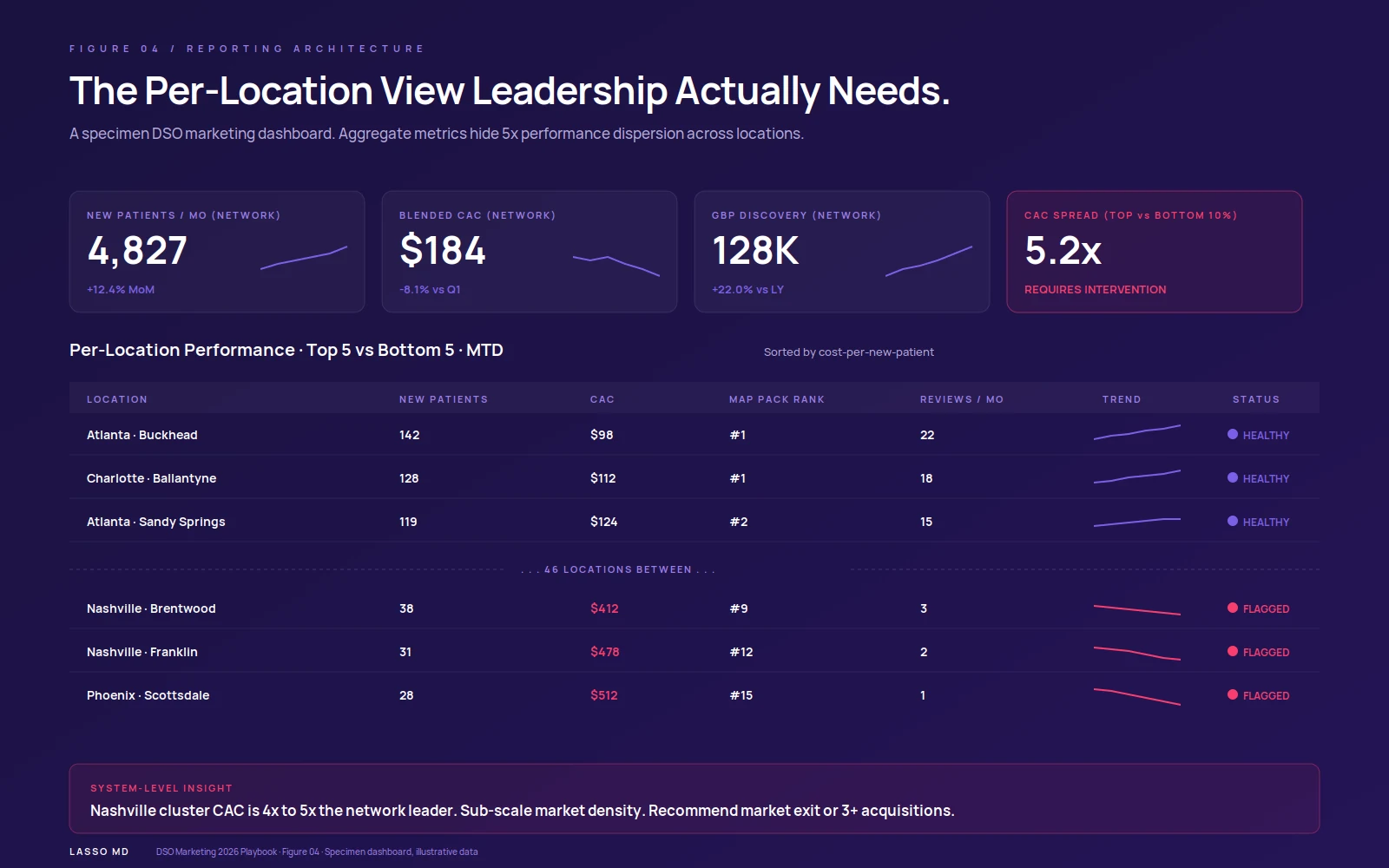


The marketing playbook that grows a single dental practice does not simply multiply across ten locations. Some parts scale cleanly and get cheaper per site as you grow. Others break in ways that are expensive and slow to diagnose, and they are almost always the parts a group tries hardest to centralize. Having worked with practices on both sides of that transition, the difference between groups that scale marketing profitably and groups that quietly bleed spend comes down to one decision, made correctly, over and over: what to centralize and what to keep local.
This post is the operating framework for that single decision. For the full end-to-end program, from org structure to channel mix, see our complete DSO marketing playbook. Think of this as the filter you run every marketing choice through.
The one rule underneath everything
Centralize what benefits from consistency and volume. Localize anything tied to a specific building and a specific patient's choice. Almost every multi-location marketing success and failure traces back to whether a group applied that rule to a given function, or got it backwards. Let's walk both columns.
What scales cleanly (centralize it)
Brand system and creative templates. A consistent visual identity, message framework, and reusable creative templates get more valuable with every location you add. Build them once, well, and every new site inherits a proven foundation. This is the rare area where full centralization is almost always right, and where letting each office freelance its own branding destroys value.
Paid ad infrastructure. Campaign structures, conversion tracking, bidding strategy, and audience logic can be templated and cloned per location. The architecture of a well-built Google Ads campaign transfers cleanly; what changes per site is the targeting radius, the local budget, and the specific service emphasis, not the underlying build. Centralizing the infrastructure while localizing the inputs is the winning pattern.
Measurement and reporting. A single source of truth for cost per booked patient across every location is not optional at scale. It is the thing that lets you see which sites are winning, which are bleeding spend, and where to move budget next. Standardized ROI tracking across all locations is one of the biggest structural advantages a group holds over independent practices, but only if it is implemented identically everywhere. Inconsistent tracking is worse than none, because it produces confident, wrong decisions.
Technology and vendor contracts. One website platform, one call-tracking system, one scheduling tool, negotiated once at group scale. Consolidating here lowers cost and, just as importantly, makes the standardized measurement above actually possible.
What breaks (localize it, at every site, every month)
Local search authority does not centralize. Ever. This is the single most common and most expensive failure. Each location needs its own fully optimized Google Business Profile, its own steady stream of local reviews, its own local citations, and its own genuinely local landing page. Groups that try to run everything through one corporate profile, or a thin templated location page with the city name swapped in, consistently lose the local map pack at every individual site. Local SEO is inherently distributed work. It does not average out from headquarters, and it cannot be done once.
Reviews cannot be pooled. Patients choose based on the reviews for the specific office they would actually visit. A group with 2,000 reviews spread thinly across twenty sites still loses a given neighborhood to one independent practice with 300 strong, recent, local reviews. Review generation has to be driven location by location, ideally as a front-desk habit at each office, not a corporate campaign.
Location-specific content. A shared "our services" page for the whole group ranks for nothing in particular. Each location competing for "implants in [city]" needs content that is actually about that city and that office: the team, the neighborhood, local considerations. Boilerplate with a find-and-replace city token is transparent to Google and to patients.
The AI search wrinkle for multi-location groups
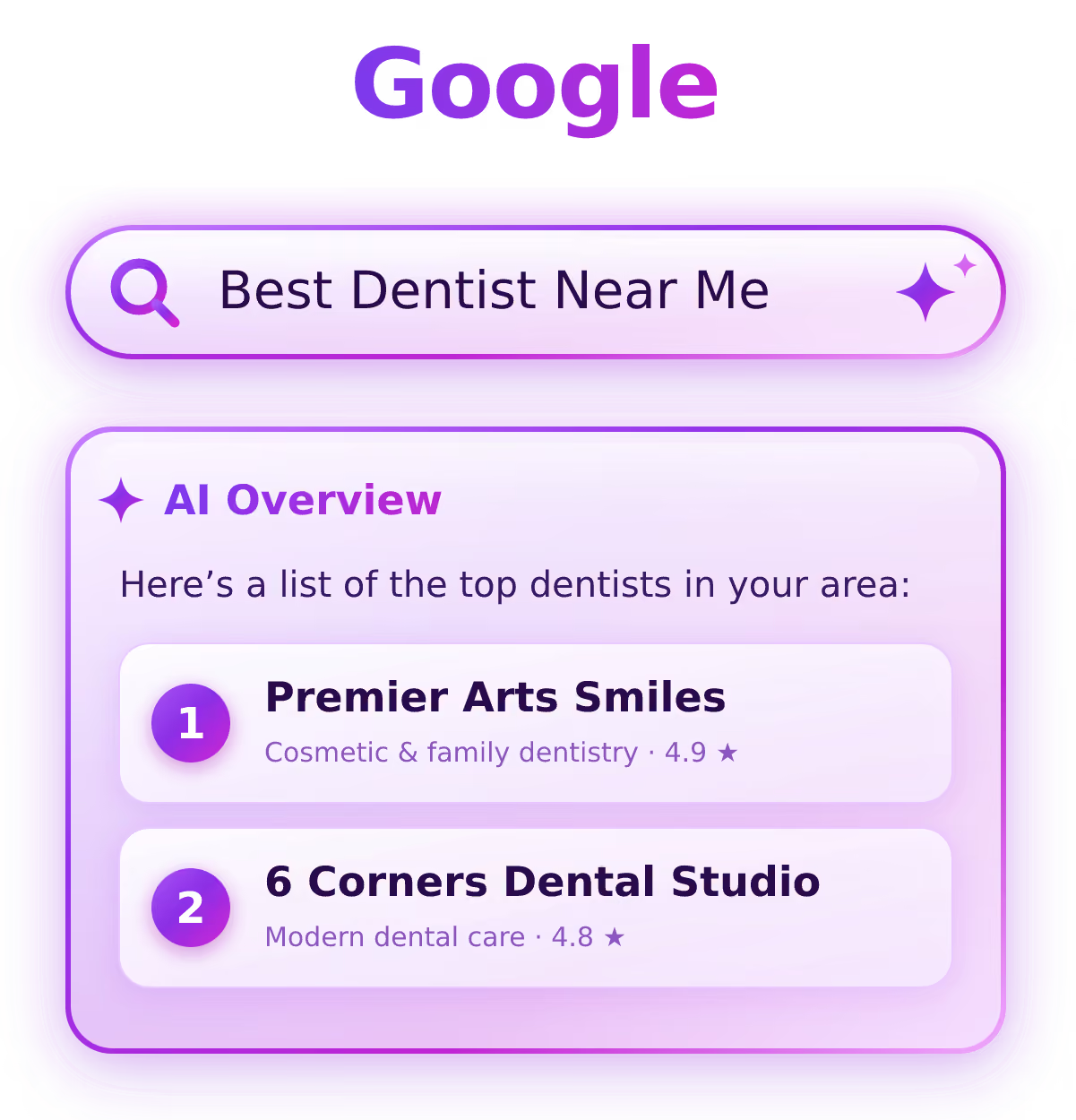
AI search adds a newer complication that punishes over-centralization even harder. When a patient asks an AI engine for a recommendation in a specific neighborhood, the engine has to confidently associate one specific location of your group with that area. Groups with clean, location-level structured data and consistent entity information are far easier for AI engines to recommend accurately. Groups with muddy, centralized, one-entity-for-everything information tend to get skipped or misattributed, the AI simply cannot tell which of your offices, if any, fits the query. I broke down how AI engines actually make these recommendations in the 2026 Dental AI Search Visibility Report.
Who owns what: the operating model
The framework only works if ownership matches it. In the groups that scale well, a central team owns brand, ad infrastructure, measurement, and technology, the consistency-and-volume column. Local accountability, often the office manager or a regional lead, owns the review habit, the accuracy of each Google Business Profile, and the local relevance of each site's content, the building-and-choice column. When a group instead pushes the local work up to corporate "to be efficient," it saves money on the org chart and loses patients at every location. When it pushes brand and tracking down to individual offices "to be responsive," it gets twenty inconsistent brands and no usable data.
The takeaway
Scaling dental marketing is not about doing more of everything centrally. It is about being disciplined regarding which column each function belongs in. Centralize brand, creative, ad infrastructure, and measurement. Localize search presence, reviews, and content, at every site, every month. Groups that hold that line grow profitably. Groups that blur it save money on paper and lose patients in practice. If you want to pressure-test where a specific group is strong or weak, the same four-part findability framework I use for single practices applies, just run it per location. You can find that audit on my site.

.avif)