


Dental practices lose about one in six of their active patients every year. The difference between a successful practice and a stalling one is planning for it. A successful practice growth plan will inherently incorporate three critical elements: where to invest (strategy), how much (budget) and how to prove it works (ROI).
Why Invest: Replace, Then Grow
Patients move, switch insurance or simply drift due to a variety of reasons. And on average, this natural attrition can run as high as 17 percent of your active patient base every year.
That means, for a practice with 2,000 active patients, ~340 of them will be lost each year. At a lifetime value (LTV) of somewhere between $5,000 and $7,000 per patient, that represents more than $1.7 million in future production walking out the door.
Even if the majority of LTV has already been captured, that practice has to replace at least $1 million in production before it sees appreciable growth at all. A winning marketing strategy requires you to invest in the eight pillars of the new patient acquisition funnel and its strategic incorporation into your practice growth plan is the only way you’ll replace those patients and grow past them.
The Strategy: Eight Pillars
1. Website Design: Turn Clicks Into Patients
Your dental practice’s website is the focal point of your new patient acquisition funnel and most of the time, it’s the first experience a prospective patient has with your practice. A high-performance dental website design has only one job: to book appointments. And it is rigorously optimized to take advantage of the traffic that you have already earned, and to ensure these visitors become patients.
Dental Website Conversion Optimization Checklist
A simple checklist practices can use to ensure their site is optimized to maximize conversions includes:
- A new patient on a phone should understand what you do and be able to book an appointment with your office in under a minute, whether that’s through a phone call or online scheduler
- Your website should have a mobile-first, scrolling friendly design that loads in under two seconds
- Online scheduling and prominent click-to-call, with a tracking number on every source
- A dedicated page for every high-value procedure: implants, aligners, sedation, emergency
- Real doctor and team photos, never stock photography
- Online patient intake so the first visit starts before the patient walks in
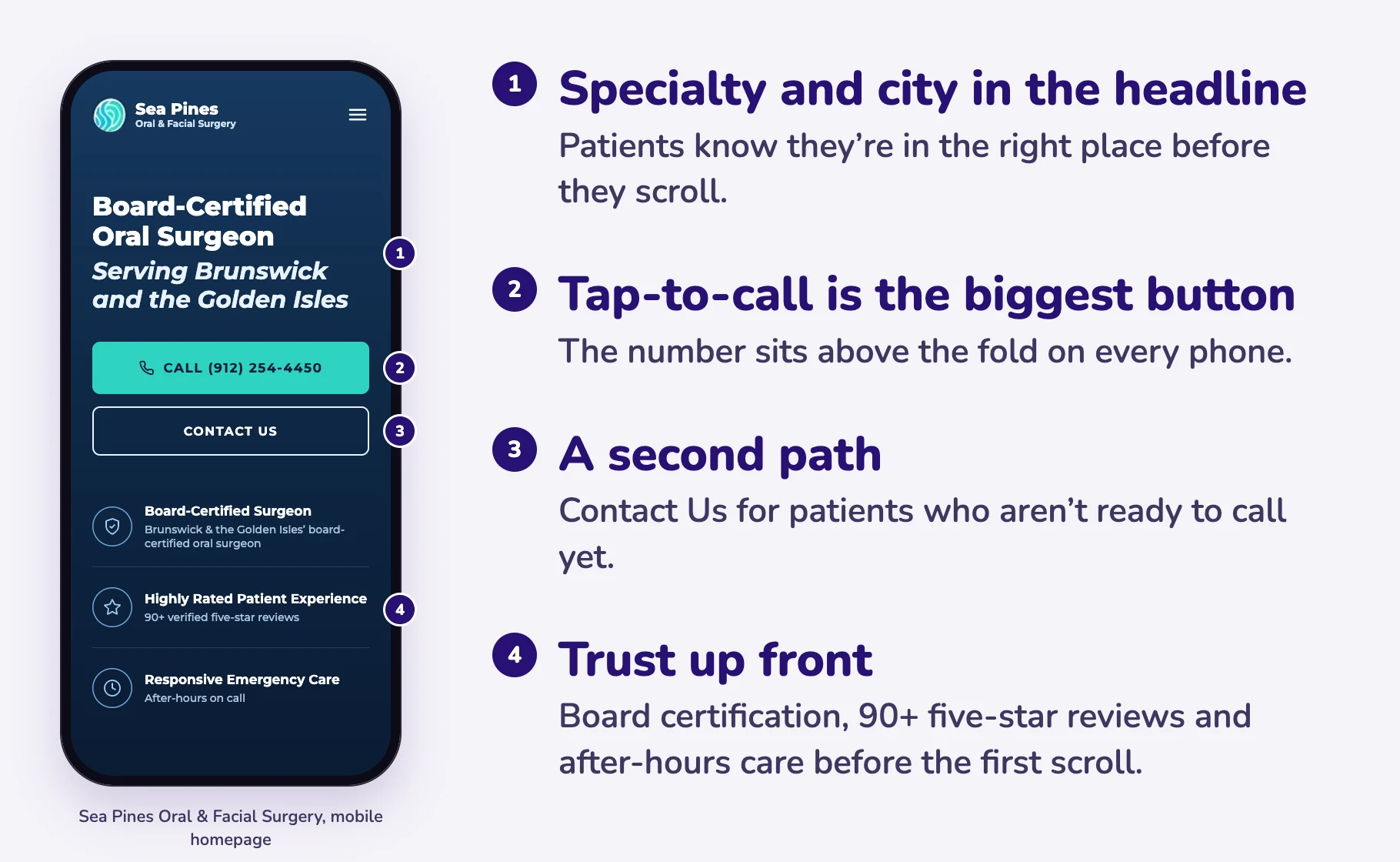
How it works today: Dental practices build out their website once, might redesign it on an annual basis and check analytics now and then.
The agentic future: AI tracks behavioral heat maps as visitors interact with the practice website, watching every visit, flagging or fixing what stops patients from booking on a continuous basis, without manual intervention, increasing conversion rates overnight. Ongoing engagement will be measured with your media content and informational service explainers to ensure they promote and sell your highest value services. Pages that are shown to have an inordinate bounce rate or poor average scroll depth will be automatically recommended for revision or deletion. Going further, measurement of content consumption for critical treatment explainers and aftercare guidelines will yield critical insights into your treatment acceptance process and the success of your informed consent programs, and how you can improve these assets to further facilitate improved clinical outcomes and care adherence.
2. Video & Photo: Show Patients Who They’ll Meet
Patients can spot stock photos from a mile away, and it’s a poor way to start a relationship that runs on trust. They want to know who they’ll actually be seeing, not someone who plays a dentist on TV. Real, personable and genuine dental practice photo and video content featuring your doctors, your team and your office is the only way to instill true clinical confidence and to deliver a conversion rate optimized experience capable of fueling the practice growth you need.
Dental Practice Photo + Video Asset Checklist
A modern, professional dental practice media toolkit includes:
- Visually stunning and emotionally evocative video and photo content that connects
- “Hero” video to showcase and highlight your passion care philosophy
- Welcoming office photos, team headshots and slice-of-life content
- Service explainers to highlight each of your highest-value services offered
- Customer testimonials to instill confidence and facilitate provider selection
How it works today: One professional shoot produces the assets every channel runs on for the year: a website hero video, a meet-the-doctor video, team and office photos and patient testimonials (with consent). The strongest practices refresh it every year because patients notice when the team on the site is not the team at the front desk.
The agentic future: AI now storyboards, edits and versions video in days instead of weeks, so one shoot becomes the website hero, a dozen ad cuts, short-form reels and captioned clips sized for every platform and service and aftercare explainer. It also automatically cuts out false starts, stutters and rushed deliveries, to maximize clinical confidence without the need to be a professional movie star. This higher quality and more direct media inherently promotes engagement and fights creative paid ads fatigue, so your return on ad spend (ROAS) and landing page conversion rates stay high. The doctor stays real: AI speeds up production, it does not replace your team on camera.
3. Local SEO: Get Found and Chosen First
When a high-intent local patient searches “dentist near me” or “dental implants in [city],” the practices in Google’s Map Pack, as well as the top 3 organic listings, get the call. The Map Pack or “3-Pack,” alone, captures 44 percent of local search volume and clicks (Local SEO Guide) on the Search Engine Results Page (SERP). Proximity, Relevance and Prominence are the key ranking factors that determine where your practice shows up and this functions separately from AI search visibility. Yes, AI recommendations are still a growing and prominent presence on search results pages, but for patients looking for immediate care that is fast, local and routine, the Map Pack dominates the above-the-fold experience, especially on mobile devices.
Hyper-Local Dental Practice SEO Optimization Checklist
To ensure your practice shows up for your prime geographic market, ensure you maintain the following:
- A complete, updated Google Business Profile (GBP) with a specific primary category, every service listed and unique practice and dentist photos
- Review velocity: 10 to 15 new Google reviews a month, ideally naming the specific treatments provided
- A dedicated page on your website for each high-value service
- NAP consistency among your digital presence: website, Google (GBP) profile, directories, reviews—using the same name, address and phone across every directory
- Schema markup in the page source

How it works today: Someone pulls a ranking report each month and decides what to update.
The agentic future: A tool watches rankings and traffic daily and updates the page content and code itself when a page slips. Specifically, this marketing agent will monitor your core “Dentist Near Me” visibility and your “Near Me” visibility for your highest-value dental services, such as Same-Day/Emergency Care and Dental Implants to ensure you show up when a prospective patient is searching in your target geographic market. This agent will automatically analyze your NAP data consistency, E-E-A-T authority and GBP utilization to maximize the efficiency of both your practice website and GBP new patient conversion and intake journeys, suggesting improvements in content and function that you can approve and implement within seconds. One of the easiest wins of the agentic future will also be the ability of local SEO dental marketing agents to tailor alerts and updates based on positioning relative to the specific set of competitors serving patients in your area, automatically surfacing new threats for you to approve and monitor, and gap fixes to execute in real time so your practice outranks the competition.
4. AI Search: Be the Practice AI Recommends
Patients now ask ChatGPT, Gemini and Google’s AI Overviews which dentist they should see, and they get two or three names, not ten links. In contrast to the Map Pack, AI mentions matter more for new patient growth when the search is (1) considered, about a (2) high-value service and poses a (3) specific question. One of the most critical tenets of mastering AI Search visibility for dental practices is that the practice an AI engine can actually understand is invariably the one it recommends. Nine in ten practices we audit are missing the structured data that makes that possible (Dental AI Visibility Schema Guide).
Dental AI Search Visibility Checklist
Ensure AI recommends your practice for high-intent queries by optimizing the following:
- Robust service pages that open with a plain definition, then cover candidacy, cost and recovery in labeled, self-contained sections an AI can lift and quote
- Provide lists of FAQs that answer the exact question in the first sentence, written the way patients ask AI (i.e. How long does Invisalign treatment take?)
- Provide real price ranges on a standalone costs page, with and without insurance (which most practices hide)
- Comparison content that aids conversational decision making (i.e. Implants vs Dentures)
- Structured schema data at the doctor level linking dentists to their credentials and specialties as well as mentions on credible third-party sources that AI trusts, like FindaDentist.ADA.org
- Recent reviews that mention the specific procedure by name
To check where you stand, ask two or three AI engines for a [treatment] dentist in your city. If you are not named, or you are described wrong, that is the gap.
How it works today: You make your site easy for ChatGPT and Google’s AI to read and recommend.
The agentic future: By analyzing a comprehensive array of synthetically generated and established core service prompts, your dental marketing agent will alert you to new trending conversational queries that are rising in importance to your practice’s unique new patient discovery and acquisition funnel, highlighting content and answer gaps in your online presence and practice website for immediate updates. This will allow your practice to continue to win the AI visibility optimization battle and provide sufficient generative engine authority and logical clarity to correctly extrapolate (generate) and answer novel conversational queries.
Recommendation will merely be the first step. Next, the patient’s personal AI assistant will act on their behalf: comparing practices, checking insurance coverage and requesting the appointment. The practice with clean data and integrated online scheduling an agent can use will get booked. The rest get skipped.
5. Social Media: Activate Your Social Patient Base
An organic social media presence (i.e. Meta: Facebook, Instagram, etc.) will not fill a practice schedule on its own; however, it keeps current patients engaged, gives new ones a look inside before they book and builds the audience your ads later retarget. Successful dental social media marketing is about true engagement and consistency, ensuring you turn loyal followers into lifelong patients.
Dental Practice Social Media Checklist
To ensure that you are making the most of your social media presence, you should:
- Ensure your profile is complete and optimized for conversions, with a booking link and automated welcome and away messaging
- Post four to eight times a month featuring your real team, office and patient stories
- Record clinical highlights and video shorts of service overviews and before and after success
- Regularly publish seasonal and holiday posts and tap into timely production boosting trends (i.e. unused benefits in the fall, a fresh start in January)
- Avoid stock photography
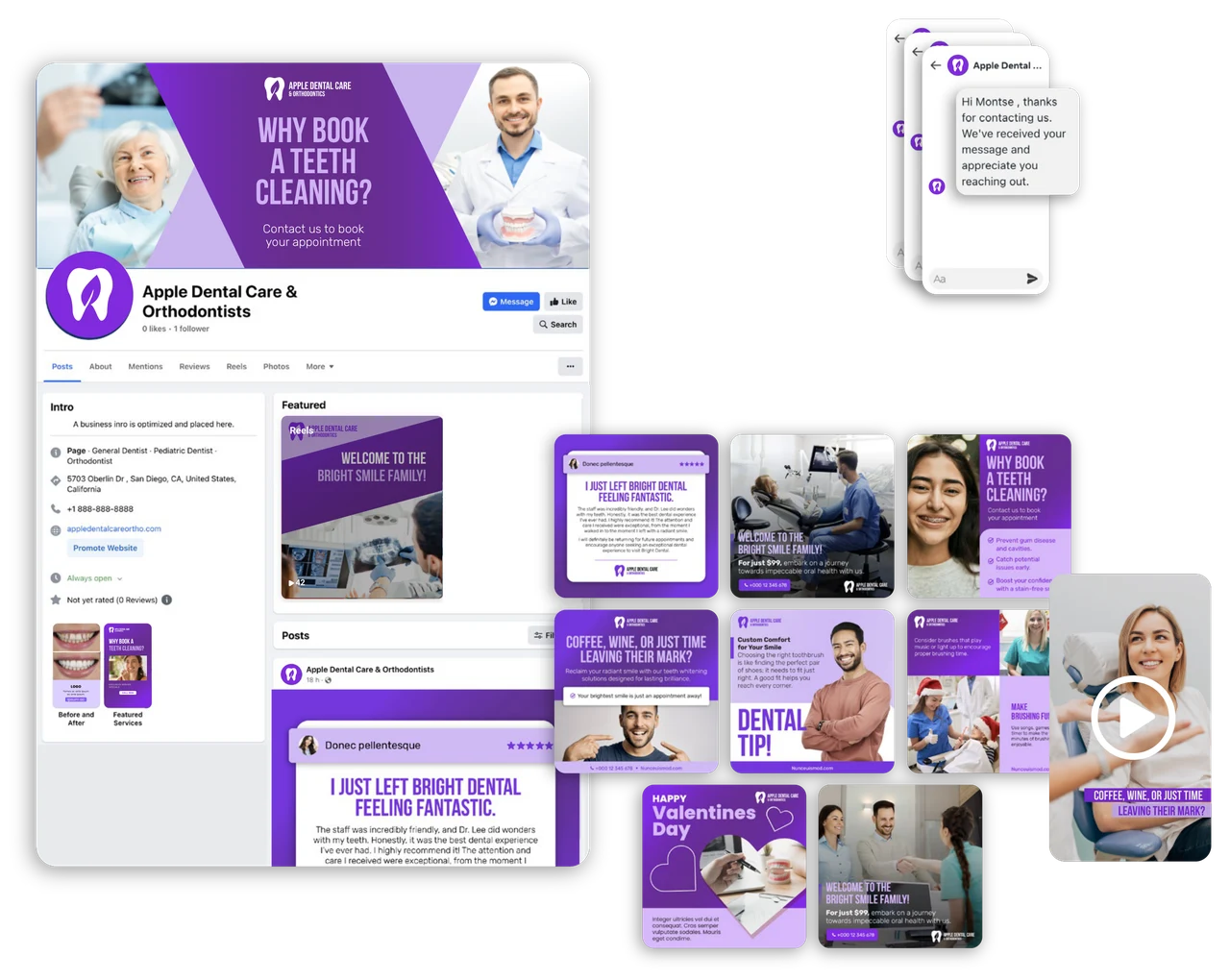
How it works today: Someone plans, writes and posts each month.
The agentic future: The content calendar builds itself. A dental social media marketing agent drafts a month of posts from what is actually happening in your practice: the new CBCT scanner, a team anniversary, the patient who just finished aligners. It sizes the creative for each platform and queues them up for your approval, so five minutes of review replaces an afternoon of creating. Posts are scheduled and posted live without additional front desk time. Going further, the agent recommends opportunities for boosting your organic posts to increase reach and exposure and recommends conversations to comment on to spread your reach, with one-click approval.
6. Meta Ads: Reach Patients Who Aren’t Searching Yet
Meta puts your practice in front of Instagram and Facebook users before they ever search. Where it wins is with high-value cases such as aligners, implants and other cosmetic procedures from people who’ve been thinking about their smile for months and just need a reason to book.
Meta shows your ad to people who are most likely to stop and click, making what’s in the ad more important than any other marketing channel.
Show a real patient, name the treatment and include a number, like a monthly payment or an available consult date. People thinking about that treatment will stop, while everyone else scrolls past, and that’s exactly what you want, spending your ad budget on those that are likely to be your next patient.
Meta Ads for Dental Practices Checklist
Maximize your paid social campaign results with this pre-launch checklist:
- One campaign per service, a broad audience and four to six creatives
- Objective set to Leads, not Traffic or Engagement
- $1,500 to $2,500 a month per campaign as the floor
- Every lead texted within five minutes, then called
- Retargeting for your own patient list and recent site visitors
Want to learn more about how to run Meta ads for your dental practice? Read our free 7 Facebook and Instagram Ads That Fill the Chair playbook.
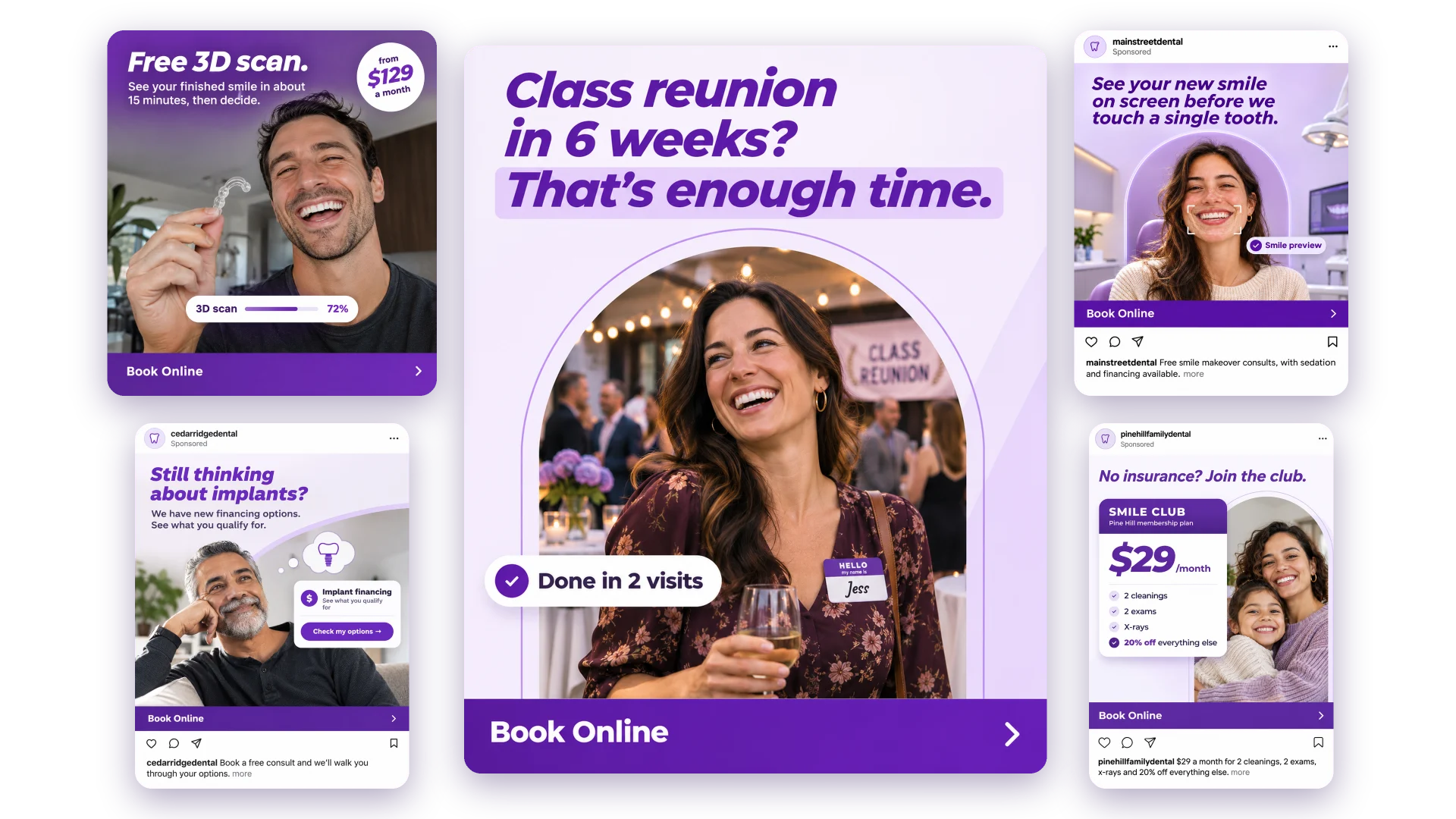
How it works today: A person makes a few ads and runs them until they wear out, then makes more.
The agentic future: Creative fatigue is the real constraint on Meta. Performance drops in just weeks, so each campaign needs three or four new creatives a month. AI can now make and A/B test new versions of an ad every week, moving budget to the one producing booked consults, not cheap form fills. When your competitor launches a rival campaign that starts trending, your AI agent will provide immediate alerts with automatic suggestions for improvement.
7. Google Ads: Reach Patients Searching Right Now
Google is the first place high-intent patients go when they already know they need you and they are ready to book: same-day/emergency visits, dental implants and cosmetic procedures. Even with recent changes in AI search behavior, it is still the fastest marketing channel to acquire new patients and the one to prioritize first, if you need your calendar booked this month.
The hallmark of highly performing Google Ads for dental practices is exceptional ad creative that gets the click, landing pages that seamlessly convert and a streamlined new patient intake process that ensures they make it to the chair.
Dental Marketing Google Ads Checklist
When building your Google Ads campaign, follow this guide to improve conversions and reduce cost:
- Separate campaigns for each high-value service you want to target: emergency, cosmetic (i.e. veneers), implants and clear aligners
- Ad groups built using only exact-match keywords, over phrase match, that also incorporate a targeted negatives list that improves candidacy and acceptance (i.e. jobs, dental schools, DIY and insurance plans you do not accept)
- A dedicated landing page per campaign that matches the ad’s promise
- A dedicated phone number for call tracking on every ad and an educated and trained front office staff ready to facilitate new patient intake

Remember, when evaluating the success of your Google Ads campaigns, be sure not to judge solely based on cost per click (CPC) or cost per lead (CPL); dive deeper into the actual return on ad spend (ROAS) and ROI based on cost per new patient (CPA). A $40 emergency click that books at 60 percent beats a $12 cosmetic click that books at 8 percent. Until you look at the adjusted production you collected based on the actual CDT procedural care you delivered, true visibility will be elusive.
Before launching your first Google Ads campaign, review Lasso MD’s Top 5 Highest-Performing PPC Campaigns for Dentists.
How it works today: Campaign bidding strategies are optimized for maximum clicks or maximum conversions (i.e. form fills and phone calls).
The agentic future: Google’s bidding algorithm is already powered by AI to dynamically extrapolate ad copy based on search term performance, and tools such as AI Max preferentially match searches with uniquely generated permutations of your practice messaging in an attempt to gauge relevancy and intent behavior. The advantage to capitalize on in the future is the quality of feedback you can provide the system on the value it has generated. Agentic systems will provide sanitized information on confirmed booked appointments and production revenue, through direct syncing to the PMS, back into Google, allowing the algorithm to optimize on new patient revenue per CDT code groupings, LTV extrapolations and time in the chair. Without this higher quality data, you’ll continue to feed it form fills and it will find you more “cheap” form fills.
8. Growth Tracking: PatientLoop™
Investing in your website, SEO, AI Search, social and paid ads without knowing what it brings back is guesswork. Google and Meta can tell you a lead came in. They can’t tell you that the $12 lead booked, accepted treatment and produced $20,000 for your practice over the next few years.
Closed-loop, complete end-to-end software platforms, like PatientLoop™, connect your marketing efforts to your practice management system (i.e. Dentrix, Dentrix Ascend, Open Dental, Eaglesoft, Denticon, Curve and 200+ others), allowing you to follow every lead from first click to booked appointment to revenue.
New Patient Growth Visibility Checklist
Ensure you have the transparency and insights to grow your dental practice successfully in 2027 with:
- A true lead CRM that allows for granular lead tracking and complete marketing channel attribution, including lead summaries and conversion insights
- Call tracking, AI-powered call analysis and front office grading with digital voice recordings to show who called, from which source and whether they booked, with missed-call-to-text and form-fill autodialer to augment your front desk staff
- Complete visibility of the leads’ new patient intake journey, with automated SMS/text message nurturing for leads who did not schedule on the first inquiry
- An ROI and growth tracking dashboard with revenue by marketing channel and by CDT treatment code group, detailing adjusted production as well as anticipated collections from the treatment plan
- Automated review requests and online scheduling to accelerate the new patient discovery flywheel
- SEO
- Social
- Paid
Attribution by channel, read from your practice management system and updated in real time.
The agentic future: Your marketing CMO. A full-time chief marketing officer is not on most practices’ org charts. That is where PatientLoop is headed: a CMO every doctor has access to. It looks at the incremental contributions from each of your marketing channels, analyzing your cost or ad spend, calls and production together, and tells you what to change. Move $1,000 from this campaign to that one. Coach this front desk call. Fix this page: it is leaking implant consults.
Budget: How Much to Spend to Achieve Double-Digit Growth
Budget for the new patients you need, not just a percentage of last year’s revenue. The industry average of 3 to 5 percent for your marketing budget often doesn’t cut it when the goal is double-digit growth.
| Stage | Typical marketing budget | Fund first |
|---|---|---|
| New practice | 7–10% of projected first-year revenue, stepping down to 4–6% as organic matures | Website live 90–120 days before opening, Google Business Profile, Google Ads |
| Established practice | 3–5% is average; double-digit growth usually takes more | Website and SEO / AI Search, Google Ads, then Meta Ads |
| Multi-location group | 4–7% of revenue | Shared brand, ads and tracking; local SEO and reviews at every location |
Sources: new practice launch timeline, DSO playbook.
Work backward from your number. Take your monthly new patient target, decide how many each channel should deliver and multiply by its cost per new patient. If Google Ads needs to deliver 20 new patients a month at $150 each, that is $3,000 a month in ad spend.
Typical ranges for a single practice:
- Organic marketing (website, hosting, SEO, AI Search, content): $10,000 to $50,000 a year, depending on competition
- Paid ad spend: $15,000 to $100,000 a year, with most practices between $30,000 and $60,000
- Google and Meta together: roughly 60/40 toward search
- Meta: fund one campaign at $1,500 to $2,500 a month before adding a second, and give retargeting 10 percent
Keep raising paid spend while cost per booked patient holds. When it starts to climb, you have found the point of diminishing returns.
ROI: How to Prove It Works
ROI is the production revenue you can trace to a channel, minus what that channel cost, divided by what it cost. Clicks, impressions, followers and leads are steps on the way, not the answer.
Measure in this order:
- Cost per lead
- Cost per booked patient
- Show rate
- Treatment accepted
- Production revenue by channel
The order matters because the cheap number lies. A campaign at $52 a lead with a 9 percent show rate looks better in Ads Manager than one at $140 a lead with a 60 percent show rate, and it is worth a fraction as much.
What good looks like. Over 90 percent of Lasso MD clients see a 3X to 5X return in their first 12 months and in a detailed study across 216 locations on PatientLoop in Q1 2026, median ROI was 708 percent. Check out our ROI Study Methodology here. With Lasso MD, you can expect better rankings, traffic and calls in 30 to 60 days and significant new patient growth by month six.
Count the lifetime value (LTV). First-visit production understates the return. A patient worth an LTV of $5,000 to $7,000 over the relationship who costs a few hundred dollars to acquire pays back many times over. And with our 3X ROI guarantee, the floor is in writing on qualifying plans.